When Revenue Growth Stops Converting Into Cash
One of the easiest ways to become comfortable with a company is to look at its revenue growth. Sales are rising, profits look healthy, and management sounds confident. Everything appears to be moving in the right direction. But sometimes, if you look deeper into the financials, you’ll notice something strange: the profits keep growing, but the cash flow doesn’t. That gap is often where the early signs of stress begin.
A lot of investors assume that if a company reports strong earnings, the business must also be generating strong cash flow. In reality, those are two very different things. A company can report revenue today while the actual cash comes much later. To some extent, that’s completely normal. But when reported profits continue rising while operating cash flow stays weak for years, it deserves attention. Over long periods, healthy businesses usually convert a meaningful portion of their profits into actual cash. When that stops happening consistently, something underneath may be changing.
The Problem Usually Starts Quietly
This is why most investors miss it. The early warning signs rarely look dramatic. You’ll often see small shifts like receivables growing faster than sales, operating cash flow trailing reported PAT, inventory slowly building up, or working capital consuming more cash every year.
Individually, none of these automatically mean something is wrong. That’s important: not every weak cash flow quarter is a red flag. Some businesses naturally go through expansion cycles, seasonal working capital pressure, or delayed collections. But when multiple signals start appearing together repeatedly, the quality of growth becomes harder to ignore.
One Example: “Cash Conversion Deficit”
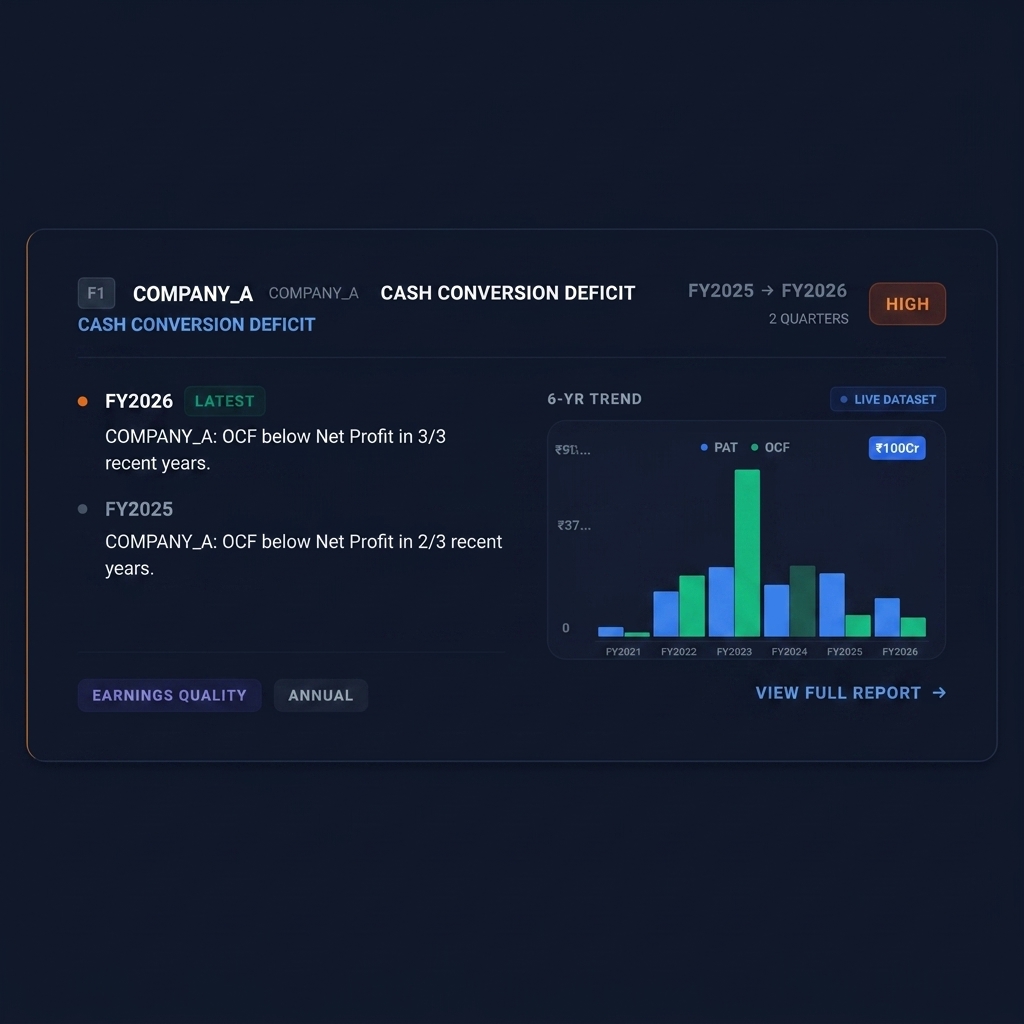
This is exactly why Flagium tracks a forensic signal called the Cash Conversion Deficit. The idea behind the flag is simple: if a company consistently reports profits, but operating cash flow remains significantly weaker over multiple years, the earnings quality deserves a closer look.
Sometimes the business still looks perfectly healthy on the surface—revenue growth remains strong, margins stay stable, and the narrative sounds optimistic. But underneath, the actual cash generation keeps lagging. That gap matters, because eventually, businesses run on cash, not accounting comfort.
For example, when operating cash flow remains below net profit for several reporting periods, it can indicate stretched working capital, weakening collection efficiency, aggressive revenue recognition, or rising dependence on accounting earnings instead of real cash generation. None of this automatically means fraud or manipulation, but it does mean the underlying financial quality may not be as strong as the headline profit numbers suggest. That’s why Flagium treats prolonged cash conversion weakness as an early forensic signal worth monitoring carefully.
Why Markets Ignore This During Bull Runs
In strong markets, very few people want to question growth. As long as earnings are rising, the stock price is moving up, and management commentary remains positive, most investors stop digging deeper.
Honestly, that’s human nature. Cash flow analysis feels boring when the market is rewarding optimism. But some of the biggest financial deteriorations begin exactly like this: strong reported growth, weakening cash conversion, and rising balance sheet pressure underneath. The stress builds slowly, and by the time it becomes visible in earnings or price action, the market usually reacts much faster than investors expect.
Why Experienced Investors Watch Cash Flow Closely
Over long periods, genuinely strong businesses tend to show consistency between profits and cash generation. It may not happen perfectly every quarter, but it should be reasonably consistent over time. Because eventually, suppliers need payment, debt obligations must be serviced, salaries must be paid, and expansion requires real funding. Cash flow forces financial reality into the system.
That’s why experienced forensic investors spend so much time studying operating cash flow, receivable cycles, working capital trends, and cash conversion quality. Not because these metrics predict everything, but because weakening cash quality is often one of the earliest visible signs that the underlying health of a business may be changing.
Where Flagium Fits In
One of Flagium’s core objectives is to continuously monitor these kinds of slow-moving forensic signals before they become obvious to the broader market. The goal is not to create panic or predict collapses, but to help investors notice when the quality of growth starts diverging from the story being presented on the surface. In investing, major problems rarely appear all at once; they usually begin as small inconsistencies people ignore during good times.
Flagium is an algorithmic financial analysis tool for informational purposes only. It does not provide investment advice or recommendations. Please consult a SEBI-registered professional before making investment decisions.