June 3, 2026
What is NIM Compression?
The Answer
Net Interest Margin (NIM) compression is the shrinking difference between the interest a financial institution earns on loans and the interest it pays to depositors. It represents the 'gross margin' of the banking world. Compression occurs when funding costs rise faster than lending yields, or when competition forces a bank to lower its rates to retain market share.
Why it Matters
For banks and NBFCs, NIM is the primary engine of capital generation. Persistent compression doesn't just lower profits; it neutralizes the institution’s ability to build 'Safety Buffers' against future loan defaults. When spreads tighten, the structural foundation of the bank's profitability is compromised.
Sentinel Insight
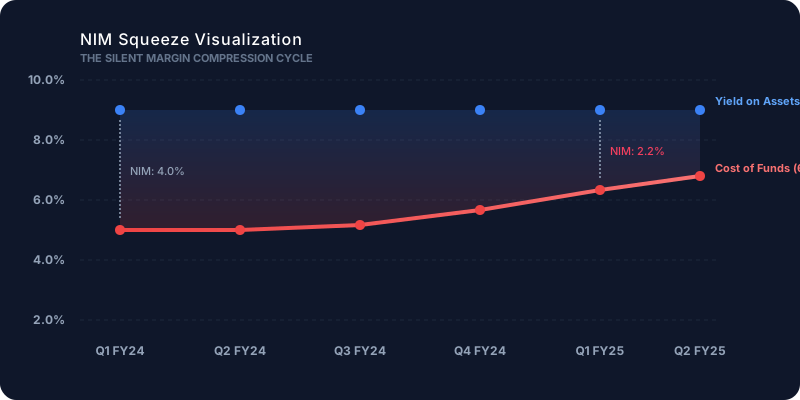
“NIM compression is a critical leading indicator of structural margin pressure. Monitor the gap between Yield on Assets and Cost of Funds; a classic example is the mid-tier banking stress where rising deposit costs squeezed margins across the board.”
📊 How to Interpret
In Risk Context
In a professional risk framework, NIM compression is viewed as a 'Strategic Redline.' Persistent compression exceeding 25bps across multiple quarters may indicate weakening pricing power and deserves further investigation. This often leads to a 'Margin Trap' where the bank must either shrink its balance sheet or take on excessive credit risk (Yield Chasing) to maintain nominal returns. It is the silent precursor to structural deterioration in the financial sector.
Deep Dive
How NIM Compression Happens
To understand Net Interest Margin (NIM) compression, it helps to look at the basic math of a bank's business model. A bank operates by taking in deposits (for which it pays interest) and lending those funds out as loans (for which it charges interest). The difference between what the bank earns and what it pays is its Net Interest Margin.
The Math of Margin Shrinkage
Consider this simple example of a bank's loan-deposit spread:
- Initial Scenario:
- Interest earned on loans (Yield on Assets): 9.0%
- Interest paid on deposits (Cost of Funds): 5.0%
- Net Interest Margin (NIM) = 4.0%
A standard way to define Net Interest Margin is:
- Compressed Scenario:
- Due to rising competition and tight liquidity, deposit costs rise to 6.0%.
- However, because of fixed-rate loans or high competition in the lending market, the bank's loan yield remains stuck at 9.0%.
- Net Interest Margin (NIM) falls to 3.0%
This reduction from 4.0% to 3.0% is NIM Compression. While a 1.0% drop might seem small, for a bank with a large loan book, it represents a massive decline in profitability and capital generation capability.
What Causes NIM Compression?
NIM compression is rarely caused by a single factor. Usually, it is the result of macroeconomic cycles combined with intense market competition.
- Rising Deposit Costs: During periods of high inflation or tight liquidity, central banks raise interest rates. Banks are forced to compete aggressively for depositors' money by offering higher interest rates on savings and term deposits, raising their overall Cost of Funds.
- Falling Lending Rates: When the economy slows down or interest rates drop, the yields on a bank's floating-rate assets decline. Additionally, a bank may be forced to lower lending rates to attract creditworthy borrowers.
- Weak CASA Growth: Current Account and Savings Account (CASA) deposits are a bank's lowest-cost source of funds. If CASA growth slows, banks must rely more on expensive term deposits (Fixed Deposits) or wholesale market borrowings, pushing up deposit costs.
- Competitive Lending Environment: If too many lenders are chasing too few high-quality borrowers, pricing power disappears. Banks slash interest rates on loans (yield compression) just to maintain their market share.
- Regulatory Pressure: Regulators may enforce rules that cap certain fees, change lending benchmarks, or require banks to hold higher cash reserves (like the Cash Reserve Ratio or CRR), which earn zero interest.
Early Warning Signs
For forensic investors, detecting NIM compression before it hurts the bottom line is crucial. Watch out for these four key signals:
- Cost of Funds Rising Faster than Yield on Assets: A widening mismatch between the speed at which deposit rates rise and loan yields reset.
- CASA Ratio Deterioration: A declining share of low-cost current and savings accounts relative to total deposits.
- Loan Growth Slowing Despite Lower Rates: The bank is cutting loan rates to stimulate borrowing, but demand remains weak.
- Successive Quarterly NIM Declines: A trend showing margins shrinking quarter-over-quarter.
Real-World Context: The 2023–2025 Banking Margin Cycle
During 2023–2025, many Indian lenders experienced margin pressure as deposit costs increased faster than lending yields. Several institutions reported sequential NIM declines despite maintaining loan growth, highlighting the challenge of preserving pricing power in a competitive deposit environment. E.g., when a lender's cost of funds rises from 5.8% to 6.7% while loan yields remain stable, its NIM compresses from 4.4% to 3.8%. Flagium detects this trajectory immediately as NIM Compression Stress.
Current Flagium Coverage
Flagium continuously monitors NIM Compression across lenders including:
- HDFC Bank (HDFCBANK)
- ICICI Bank (ICICIBANK)
- Bajaj Finance (BAJFINANCE)
- IDFC First Bank (IDFCFIRSTB)
Investors can compare how margin trends differ across institutions and identify early signs of pricing pressure.
How Flagium Detects NIM Compression
Unlike standard stock screeners that only look at annual reports, Flagium tracks real-time structural trends. Flagium monitors:
- Yield on Assets & Cost of Funds Spread: Tracks monthly and quarterly trajectories of asset yields vs. funding costs.
- Quarterly NIM Trends: Measures the acceleration or deceleration of margins.
- Pricing Power Deterioration: Analyzes whether the bank is sacrificing margins to maintain loan volume growth.
- Multi-Quarter Margin Trajectory: Flags persistent margin stress. The signal becomes stronger when margin deterioration persists across multiple reporting periods.
Related Signals
NIM compression rarely appears in isolation. When evaluating a financial institution, investors should also monitor these related metrics:
- Financial Stress: A broader measure of operational and credit pressure.
- Balance Sheet Stress: Indicates structural weakness in assets and liabilities.
- Earnings Quality: Assesses the sustainability and cash conversion of profits.
- Liquidity Risk: The ultimate threat of failing to meet short-term obligations.
- Structural Risk: Long-term business model mismatch.
- Financial Deterioration: The systematic, multi-quarter decay of corporate health.
Frequently Asked Questions (FAQ)
What is a healthy NIM?
For commercial banks, a NIM between 3.0% and 4.0% is generally considered healthy. However, retail-heavy banks and high-yield NBFCs (like microfinance institutions) may require a NIM of 5.0% to 8.0% to compensate for higher credit risk.
Is NIM Compression always bad?
Not always. A temporary dip in NIM during an aggressive expansion phase (where a bank is gathering low-yield, high-safety assets) can be healthy. However, persistent, multi-quarter compression accompanied by stagnant loan growth is a warning sign of structural weakness.
Can NIM recover?
Yes. NIM can recover if the cost of deposits starts falling, if the bank successfully shifts its loan portfolio toward higher-yielding products (like unsecured retail loans), or if interest rates on floating loans rise faster than deposit rates.
How much NIM decline is concerning?
Short-term fluctuations are common. However, persistent multi-quarter declines, especially when accompanied by rising funding costs or weakening deposit growth, deserve closer investigation.
NIM Compression vs Margin Compression?
Margin compression is a broad term applicable to any business (e.g., manufacturing, services) whose gross or operating margins are shrinking due to rising input costs. NIM compression is a specialized term specifically used for financial institutions (banks and NBFCs) referring to the spread between interest earned and interest paid.
Which Indian banks are most vulnerable to NIM Compression?
Mid-sized private banks and NBFCs that rely heavily on wholesale market funding or bulk deposits are the most vulnerable. Unlike large public sector banks (like SBI) or top-tier private banks (like HDFC Bank and ICICI Bank) that possess vast, sticky retail depositor bases, mid-tier lenders must pay a premium to attract deposits during tight liquidity cycles, exposing them to severe NIM compression.
Detect risk early
Flagium tracks these signals across multiple quarters to help you avoid structurally weak companies before it reflects in price.
Find banks with NIM compression stress →🔍