July 30, 2026
What is CASA Ratio in Banking?
The Answer
The CASA (Current Account Savings Account) ratio measures the percentage of a bank's total deposits that come from low-cost current and savings accounts. It is the bedrock of a bank's funding cost advantage; a higher CASA ratio provides cheap, sticky liquidity that shields Net Interest Margins (NIM) from rising interest rates.
Sector Focus
Why it Matters
In commercial banking, deposits are raw material. Current accounts pay 0% interest and savings accounts pay low interest (typically 3–4%), whereas term deposits (Fixed Deposits) cost 6.5–8.0%+. A high CASA ratio gives a bank superior pricing power, higher NIM resilience, and a formidable moat over competitors dependent on expensive wholesale borrowings.
Sentinel Insight
“CASA is the ultimate litmus test of a bank's retail deposit franchise. A declining CASA ratio is the single earliest leading indicator of incoming margin compression, appearing quarters before reported quarterly net profit drops.”
📊 How to Interpret
In Risk Context
Forensic banking audits analyze the 'CASA Migration Velocity.' During high-interest-rate cycles, depositors shift funds from low-yield savings accounts into high-yielding term deposits or mutual funds. When a bank's CASA ratio drops below critical sector benchmarks, its overall Cost of Funds spikes, triggering severe NIM compression unless it takes on higher credit risk.
Deep Dive
Understanding CASA and Bank Funding Mechanics
To understand banking profitability and structural resilience, one must look at where a bank gets its money. Unlike manufacturing firms that purchase raw materials from suppliers, banks purchase money from depositors.
A bank receives three primary types of deposits:
- Current Accounts (CA): Used primarily by businesses for daily transactions. They yield 0% interest.
- Savings Accounts (SA): Used by individual retail customers for personal savings. They yield low interest (typically 3.0% – 4.0% in India).
- Term / Fixed Deposits (TD): Time-bound deposits locked for 1–5 years. They yield high interest (typically 6.5% – 8.0%+).
The sum of Current Accounts and Savings Accounts forms CASA.
The CASA Ratio Formula
The Cost of Funds Spread Math
Consider two banks operating in the same Indian market:
-
Bank A (High CASA Franchise):
- CASA Ratio: 48% (Cost of CASA = 2.5% blended)
- Term Deposits: 52% (Cost of Term Deposits = 7.0%)
- Blended Cost of Funds = (0.48 × 2.5%) + (0.52 × 7.0%) = 1.20% + 3.64% = 4.84%
-
Bank B (Low CASA / Wholesale Reliant):
- CASA Ratio: 22% (Cost of CASA = 2.5% blended)
- Term Deposits / Wholesale Borrowings: 78% (Cost = 7.5%)
- Blended Cost of Funds = (0.22 × 2.5%) + (0.78 × 7.5%) = 0.55% + 5.85% = 6.40%
Bank A enjoys a massive 156 basis point (1.56%) funding cost advantage over Bank B simply because of its retail CASA franchise. This allows Bank A to lend to top-tier blue-chip corporate borrowers at lower interest rates while preserving a fat Net Interest Margin (NIM).
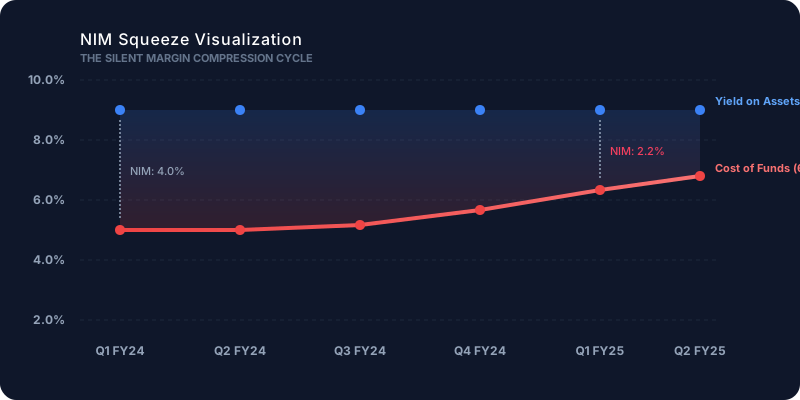
The Cascade: How CASA Deterioration Drives NIM Squeeze
When central banks raise interest rates to fight inflation, a phenomenon known as Deposit Migration occurs:
- Yield Chasing by Retail Investors: Retail depositors move money out of 3.5% savings accounts into 7.5% fixed deposits or liquid mutual funds.
- Shrinking CASA Ratio: The share of 0-4% deposits contracts as a percentage of total balance sheet liabilities.
- Surging Cost of Funds: The bank is forced to replace lost savings deposits with expensive bulk deposits or Certificate of Deposits (CDs).
- Margin Compression: Unless loan yields increase at the exact same speed, the bank's Net Interest Margin compresses immediately.
Early Warning Indicators of CASA Stress
Forensic bank analysts monitor these four warning signals:
- CASA Ratio Contracting > 150bps Year-over-Year: Indicates accelerating deposit flight to higher-yielding assets.
- Credit-to-Deposit Ratio (CDR) Surging > 85%: Credit growth is outstripping deposit growth, forcing the bank to rely on high-cost wholesale borrowing.
- Rising Cost of Deposits relative to Benchmark G-Sec: The bank is paying a premium over sovereign risk-free rates to retain depositors.
- Bulk Deposit Share > 35% of Total Funding: High reliance on volatile, price-sensitive corporate deposits rather than sticky retail CASA.
Real-World Context: The Indian Banking Deposit Wars (2023–2025)
During 2023–2025, Indian banks engaged in an aggressive "Deposit War." Following rapid credit growth post-pandemic, systemic liquidity tightened. Retail investors increasingly allocated savings toward high-return equity mutual funds (via SIPs) rather than traditional savings accounts.
As a result, major private lenders saw their CASA ratios decline by 200–400 basis points over six quarters. Lenders with sticky retail branch networks (like SBI, HDFC Bank, and Kotak Bank) managed to defend their cost of funds far better than mid-tier lenders, which saw severe NIM compression and were forced to slow loan growth.
Current Flagium Coverage
Flagium continuously monitors CASA velocity and deposit stability across key lenders:
- HDFC Bank (HDFCBANK)
- Kotak Mahindra Bank (KOTAKBANK)
- ICICI Bank (ICICIBANK)
- IDFC First Bank (IDFCFIRSTB)
How Flagium Detects CASA & Funding Vulnerability
Flagium's banking forensic engine evaluates:
- CASA Velocity Score: Measures the quarterly rate of change in low-cost deposit share.
- Blended Cost of Funds Trajectory: Tracks funding cost inflation against peer group medians.
- Deposit Stickiness Index: Evaluates retail branch density vs. wholesale bulk deposit reliance.
- Margin Vulnerability Indicator: Simulates NIM sensitivity under a 100bps deposit shift from savings to term deposits.
Related Signals
CASA risk is closely connected with:
- NIM Compression: Direct margin impact of rising deposit costs.
- Liquidity Risk: Balance sheet cash flow and funding stability.
- Structural Risk: Long-term business model capital structure design.
- Financial Stress: Systemic operational and credit pressure.
Frequently Asked Questions (FAQ)
What is a CASA ratio?
The CASA ratio is the percentage of a bank's total deposits held in Current Accounts (0% interest) and Savings Accounts (low interest). It indicates how cheaply a bank can raise funds.
Why is a high CASA ratio desirable for banks?
A high CASA ratio reduces a bank's overall Cost of Funds, allowing it to offer competitive loan rates while earning a higher Net Interest Margin (NIM) and maintaining a buffer against bad loans.
What is considered a good CASA ratio in Indian banking?
A CASA ratio above 40% is considered strong for Indian commercial banks. Top-tier private banks (like Kotak Bank and HDFC Bank) have historically maintained CASA ratios between 45% and 50%.
How does interest rate tightening affect the CASA ratio?
During high rate cycles, depositors shift money from savings accounts to fixed deposits to lock in higher returns (e.g. 7.5%+), causing the CASA ratio to decline across the banking system.
CASA Ratio vs. Credit-to-Deposit Ratio (CDR)?
The CASA ratio measures the quality and cost structure of deposits, whereas the Credit-to-Deposit Ratio measures how much of those deposits are deployed as loans. High CDR with low CASA indicates a bank stretched for liquidity.
Can non-banking financial companies (NBFCs) have a CASA ratio?
No. NBFCs are not permitted by regulators to accept demand deposits (Current and Savings Accounts). NBFCs raise funds through term deposits, debentures, commercial paper, and bank loans.
Detect risk early
Flagium tracks these signals across multiple quarters to help you avoid structurally weak companies before it reflects in price.
Screen Indian banks by CASA ratio & cost of funds →🔍